Local By Toast
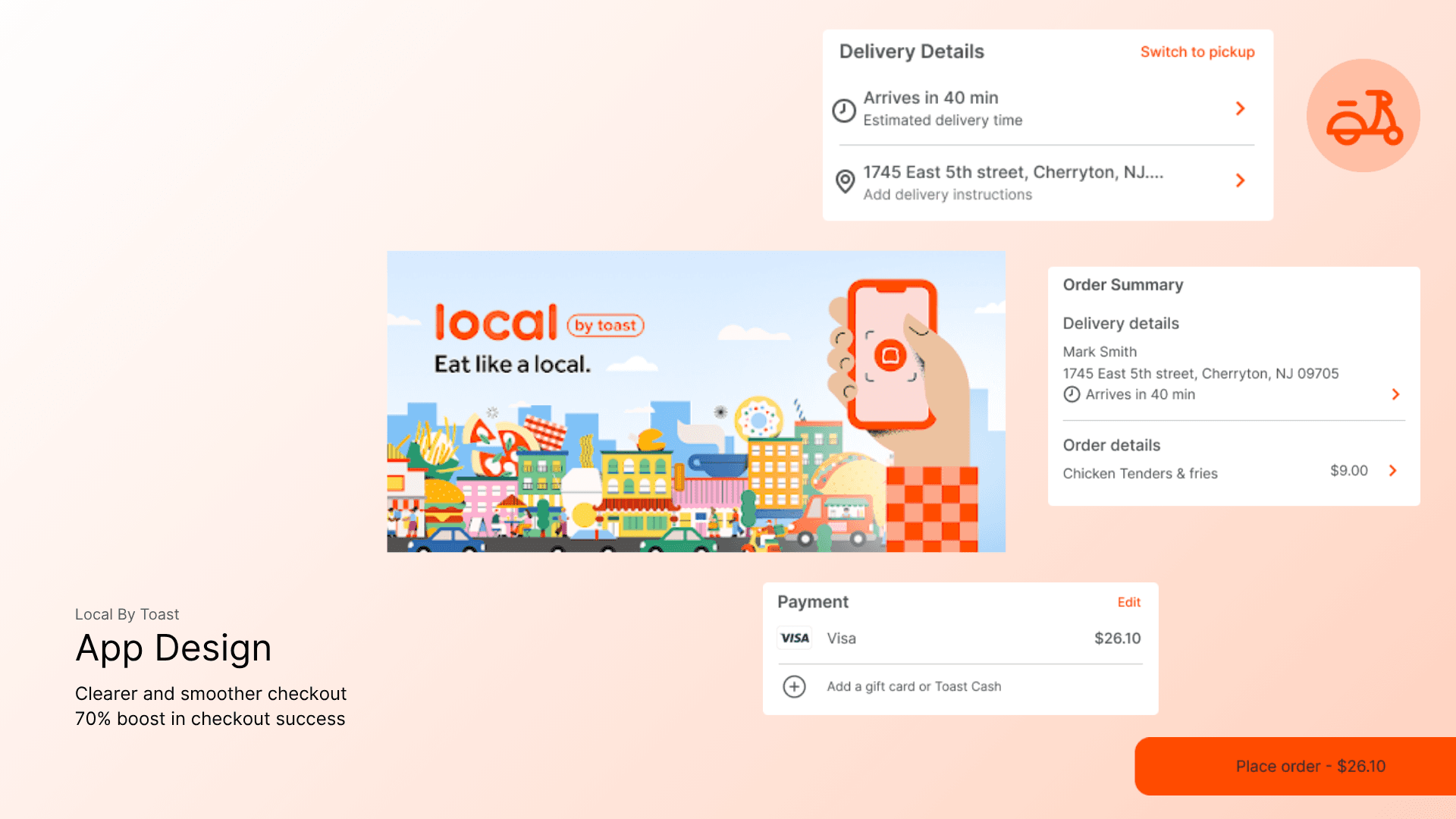
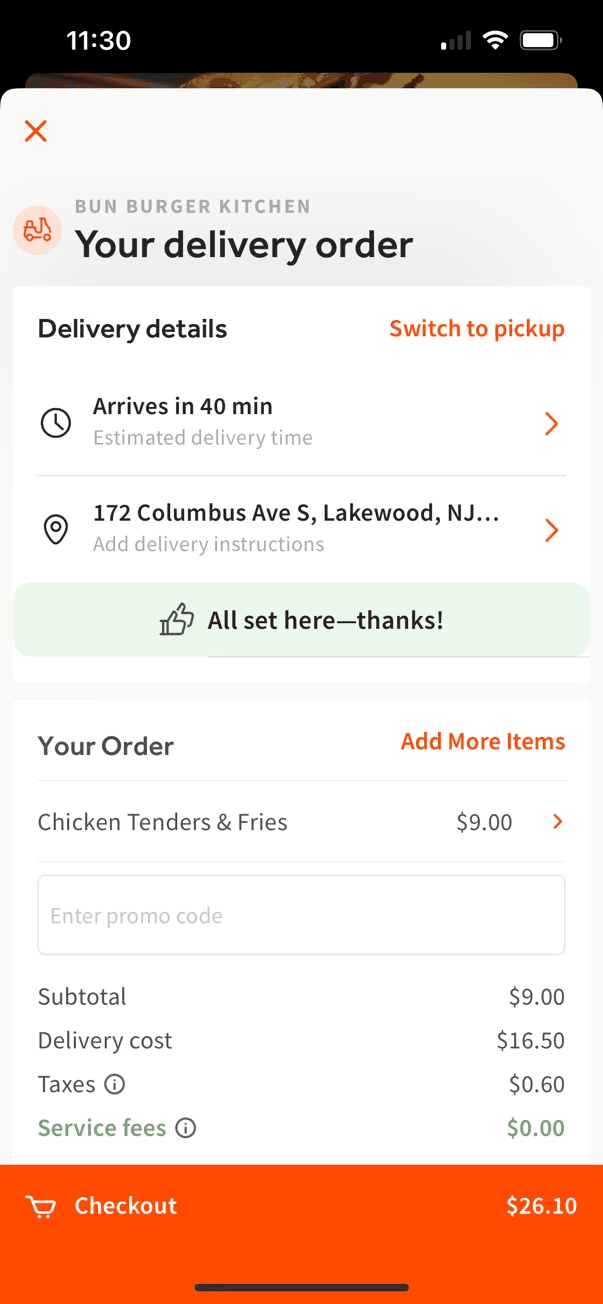
The Local by Toast checkout flow presented a key usability issue: tapping “Checkout” immediately placed the order without a review or confirmation step.
This led to user confusion and accidental submissions, as reflected in numerous Google Play Store reviews.
Redesigning the flow to include a confirmation step resulted in a 70% increase in successful checkouts.
Role:
UX/UI Designer
Tools
Figma, Miro
Year:
2025
Problem
Users are confused, unintentionally placing orders, and struggling to complete orders in the Local by Toast app due to the lack of a confirmation step and deviation from common food ordering practices.
The term “Checkout” is used inconsistently with industry norms
No opportunity to review or confirm the order
Users face friction trying to contact the store—since there’s no way to edit or cancel orders in the app, and phone numbers are often missing or go unanswered
Restaurants are burdened with misorders, cancellations, and refund requests
Solution
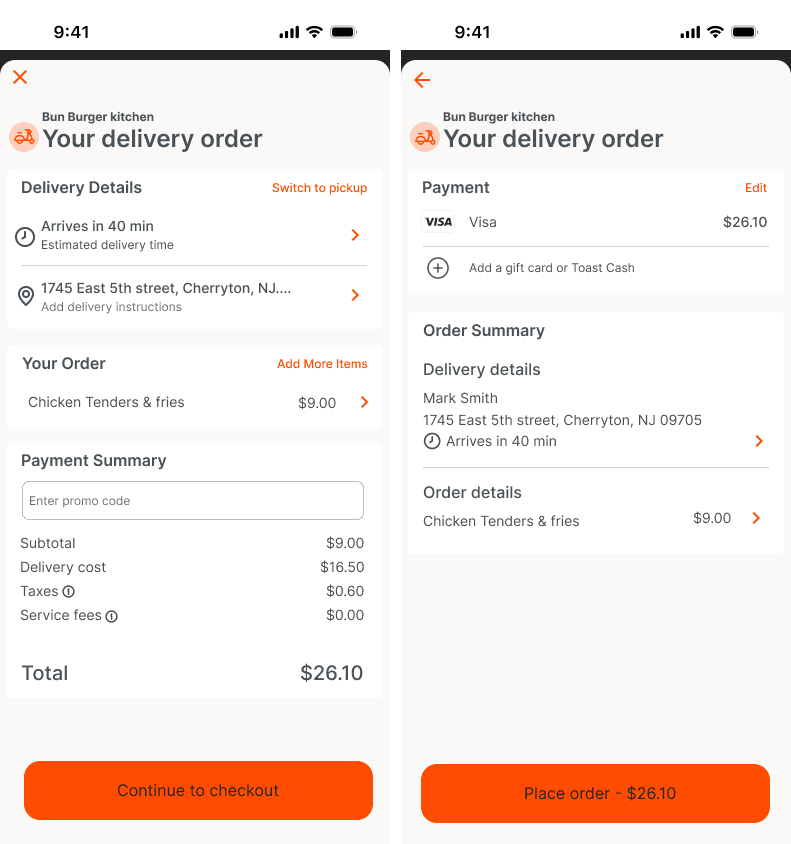
A more intuitive flow with a order confirmation screen between the cart and final submission.
“Checkout” leads to a familiar review step, not an immediate action
Users gain a clear opportunity to confirm or cancel before committing
Fewer accidental orders reduce frustration for users and operational issues for restaurant
User Research
Reading through user reviews on the Google Play Store, it quickly became clear how frustrating the checkout experience is for many Toast users.
Omar shared his struggle:
“Accidentally placed an old order. The app says to call the restaurant to cancel the order, but the restaurant doesn't pick up (on purpose) the phone. Called 18 times and each time immediately received a half ring and then it would go voicemail.”
Jayson had a similar experience, explaining:
“No confirmation request. No 'order now' option. I was just trying to see what it thought was in my cart, and it sent the order. Looked up how to cancel—there’s no way to cancel through the app, you have to call the establishment to fix it.”
Suzanne’s review stood out for its frustration and regret:
“I was trying to include delivery instructions and when I tried to enter to the next line, instead of the cursor moving, the whole order was sent through without first confirming. I didn’t finish the delivery instructions. Now I’m full of regret. No way to fix this.”
These Play Store reviews show a clear pattern - users expect a chance to confirm their order before it’s final, but the app doesn’t provide that. Instead, they’re left scrambling to fix mistakes by calling stores that often don’t answer, adding stress and dissatisfaction.
Baseline
Usability Testing
I tasked each participant to place an order using the current Toast checkout flow starting from the “View Cart” screen.
The results echoed the Play Store reviews. Users were confused and experienced hesitation throughout the process as they expected an explicit confirmation step that would let them review their order and payment details before submitting.
One user immediately asked, “Where’s the place order?” They expected a confirmation screen but struggled to find a clear way to finalize the order.
Another wondered, “Where’s the pay button?”—unsure when or how their payment would be processed.
Two others were thrown off by a message labeled “All Set.” One assumed it was a checkout button but found it unclickable, which left them stuck. The other mistook it for the final step to place the order and only realized after scrolling that the actual checkout button was elsewhere.
4
Users
30%
successful task completion
100%
Experienced confusion
Product Comparison
To understand what users expect from a food ordering app, I looked at how competitors handle checkout.
Apps like UberEats, Starbucks, and Dunkin' Donuts all include a clear confirmation step after the cart.
This extra screen provides a natural pause, helping users avoid mistakes and feel confident in their purchase. It’s a simple but crucial step that’s missing from Toast’s flow, which puts unnecessary strain on customers and restaurants alike.

Ideation & Design
After synthesizing all my research a pattern emerged - Local by Toast was missing a critical order confirmation step.
I created a second added screen in which:
users can double-check their items
verify delivery or pickup details
confirm payment
Wireframes
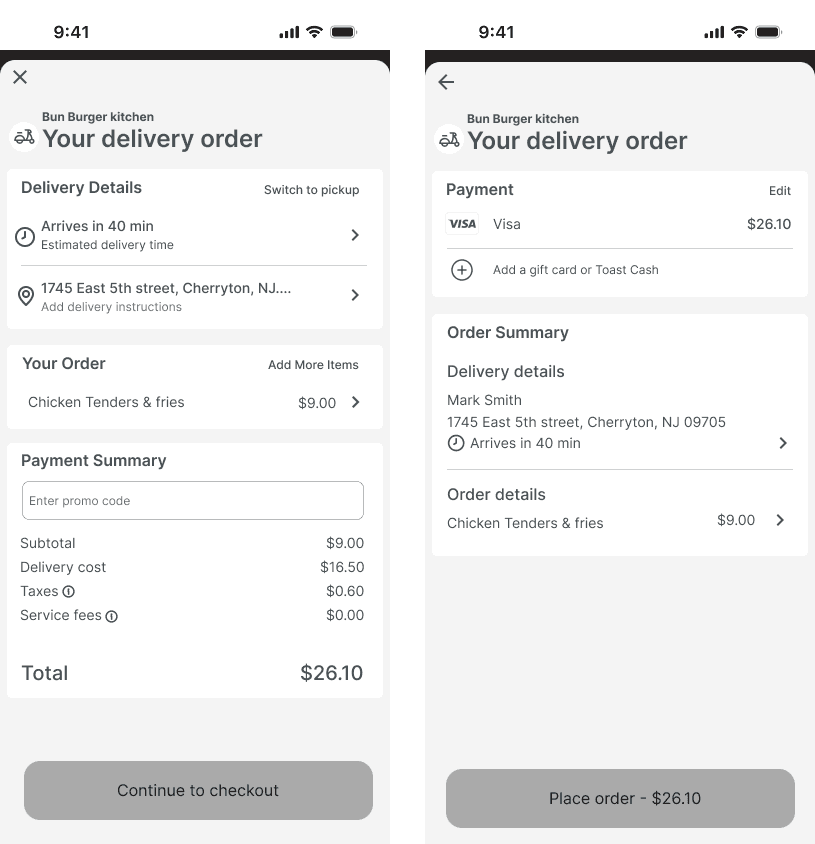
I restructured the checkout experience into two screens:
Screen 1: View Cart
Delivery method and time
Order details (with editable items and modifiers)
Cost summary + promo code entry
Primary CTA: “Next”, guiding the user forward
This screen helps users confirm that everything looks right before proceeding.
Screen 2: Confirm Order
Payment method summary
Final order overview
Clearly labeled “Place Order” button
This second screen creates a deliberate pause and aligns Toast with industry norms. The restructured flow is designed to reduce misorders, restore user trust, and relieve restaurants of avoidable refund and support issues.
Usability Testing
4
Users
100%
successful task completion
0%
Experienced confusion
To evaluate the effectiveness of the redesigned two-step checkout flow, I conducted moderated usability testing with four participants. Each user began on the “View Cart” screen and was asked to place an order using the updated flow.
The redesigned flow reduced cognitive friction and boosted user confidence, confirming that the added confirmation step better matched user expectations. All four users completed the task smoothly, without hesitation or confusion.
User 1 and User 3 described the new flow as smooth and easy to follow. They moved through each step naturally, without second-guessing what to do next.
User 2 said the experience “made more sense,” noting the clearer structure and progression.
User 4 called the interface “so much clearer now,” appreciating the improved visibility and control.
Final Prototype
Once the revised flow was wireframed and validated against best practices, I translated it into high-fidelity mockups that reflect Toast’s existing brand style and UI patterns. These screens emphasize clarity, control, and intentional action.